How long does a planning application take: timeline sheet
- Weeks left before the period runs out (negative means over)
- 2
- Computed on this page from the inputs below
- Weeks the authority has in total (statutory plus extension)
- 8
- Computed on this page from the inputs below
- Share of the period used, percent
- 75.0
- Computed on this page from the inputs below
- Earliest week a decision can land, given the committee
- 6
- Computed on this page from the inputs below
Every figure here comes from the figures you enter and the method stated beside it: your authority's fee for the type, your agent's and consultants' fees, your statutory period and your dates. Where a guide names a published figure it names the source and the date it was read. This site publishes no fee schedule it did not read on the day, no council's register and no legal opinion: what a particular authority will decide is the authority's answer, and the national guidance cited on each guide is the starting point, not the ruling.
Email me this result
We will send you these figures and a link back to them. One email, nothing else unless you tick the box.
The figures above start from a worked example (2). Change any input and the answer updates as you type, the way it will when the ecology survey comes in dearer than quoted.
Download the How long does a planning application take: timeline sheet worked example (CSV)
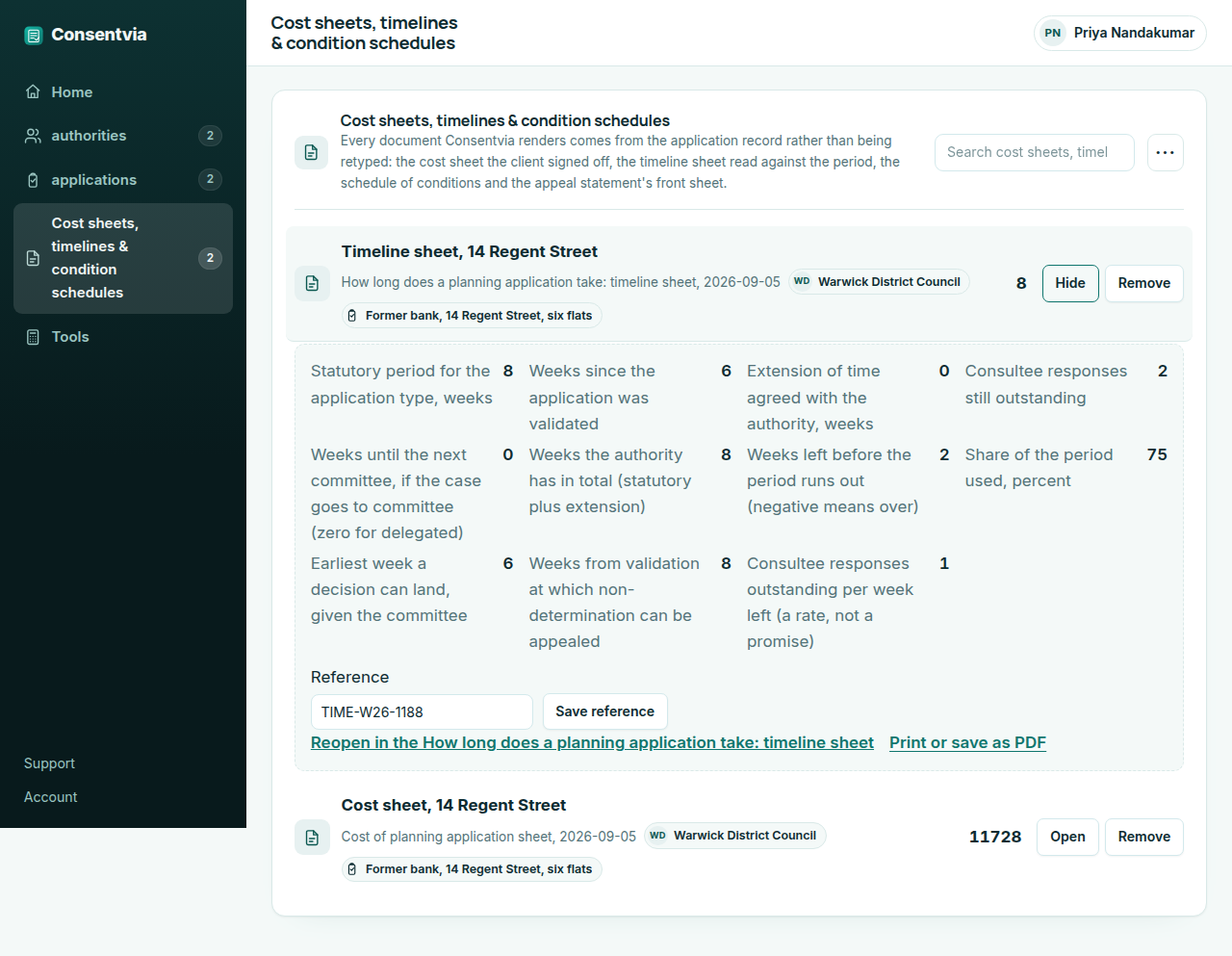
The planning application timeline sheet answers how long does a planning application take for your application rather than for an average one: the statutory period for the type, eight weeks for most applications, thirteen for a major one, sixteen where an environmental statement is needed; the weeks since the validation letter; any extension of time agreed with the authority; the consultee responses still outstanding; and the weeks until the next committee if the case goes to one. It returns the weeks the authority has in total, the weeks left before the period runs out, the share of the period used, the earliest week a decision can land given the committee, the week from which an appeal against non-determination can be made, and the outstanding responses per week left. It is the reading an applicant makes every time the client asks, with the arithmetic written down.
The clock starts at validation, not submission
The statutory period runs from the date the authority validates the application, which is the date on its letter, and an application returned for a missing survey has not started its clock. The sheet asks for the weeks since validation for that reason, and an applicant who counts from submission reads the authority as later than it is. The record keeps the validation date against the application so the reading is from the letter rather than from memory.
An extension of time is a fact only if it is written down
Authorities ask for extensions of time when the period will not be met, and applicants agree them by email and forget them. An agreed extension moves the date from which non-determination can be appealed, so an extension nobody can find is an appeal right nobody can use. The sheet takes the extension as its own input and the record keeps each one with its date; the timeline read from the sheet is then the timeline the authority would recognise.
The weeks left are a reading, and the outstanding consultees are the risk
The weeks left before the period runs out is a reading from the dates; whether the decision lands in them depends on the consultees who have not answered and on whether the case goes to committee. The sheet shows the outstanding responses per week left as a rate, so an application with four consultees outstanding and two weeks left is visibly not going to be decided in time, and the applicant can agree an extension or prepare the non-determination appeal on the day rather than after. Consentvia Pro keeps the reading against the application with the dates it was made from.
What an applicant asks before running the How long does a planning application take: timeline sheet
Which figures do I need before using the timeline sheet? The statutory period for the application type (eight weeks for most, thirteen for a major application, sixteen with an environmental statement), the validation date from the authority's letter, any extension of time agreed and its new date, how many consultees have not responded, and the date of the next committee if the case is going to one.
What happens when the period runs out without a decision? The applicant may appeal against non-determination from the end of the period or the agreed extension, or agree a further extension, or wait. The sheet shows the week from which the appeal is open; whether to use it is the applicant's judgement and the guidance cited below sets out the route.
Does the sheet cover the appeal's own timeline? No. The appeal has its own timetable set by the Planning Inspectorate and the guide on how long a planning appeal takes covers it. This sheet reads the application's period; the record keeps the appeal against the application when one is made.
Where the method in this worksheet comes from
GOV.UK planning practice guidance, Determining a planning application: the statutory periods for each application type, extensions of time and the right to appeal against non-determination. Why the sheet takes the statutory period as an input with the extension beside it: the guidance sets the periods by application type and lets the authority and the applicant agree a longer one in writing, and both decide the date from which non-determination can be appealed.
GOV.UK planning practice guidance, Consultation and pre-decision matters: the statutory consultees, their response periods and how outstanding responses bear on the decision. Why the outstanding consultees are on the sheet as a rate: the guidance gives consultees their own periods to respond, and an application cannot be decided against a missing statutory response without the authority carrying the risk.